

Mucuna Pruriens: The Dopamine Bean
An ancient Ayurvedic velvet bean, the richest natural source of L-DOPA, and the warm, joyful heart of our Pasion blend.
For three thousand years, Ayurveda has treasured Mucuna pruriens, the velvet bean, as a tonic for vitality and joy. Today it is affectionately known as the Dopamine Bean, for a simple and remarkable reason: it is the richest natural source of L-DOPA on Earth.
Known across cultures as Kapikachhu, velvet bean, cowhage and monkey tamarind, mucuna is the warm, life-affirming spark in Pasion, where it meets ceremonial cacao, rose petals and vanilla to open the heart and lift the spirit.
The Velvet Bean
Mucuna pruriens is a vigorous tropical climbing legume, native to Africa and tropical Asia, in the same great plant family as peas and beans. It twines its way up trees and trellises, hanging heavy with pods.
Those pods are covered in fine hairs that give the plant its other name, cowhage, and its reputation for being itchy to the touch. It is the seeds within, the velvet beans, that hold the plant's treasure, and the part we use.
It is also genuinely a food. In Java the beans are known as Benguk and are even fermented into a tempeh-style food called tempe Benguk. But it is the seed's natural chemistry, above all its L-DOPA, that has fascinated healers and scientists alike.

The Life of the Velvet Bean
Mucuna is a tropical climber, native to Africa and tropical Asia and now grown across the warm corners of the world. Its journey runs from a striking purple and green flower, to a hairy hanging pod, to the prized velvet bean within.
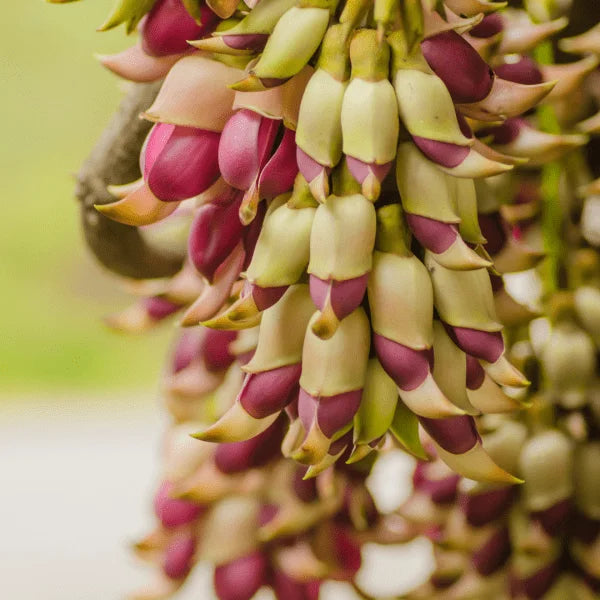
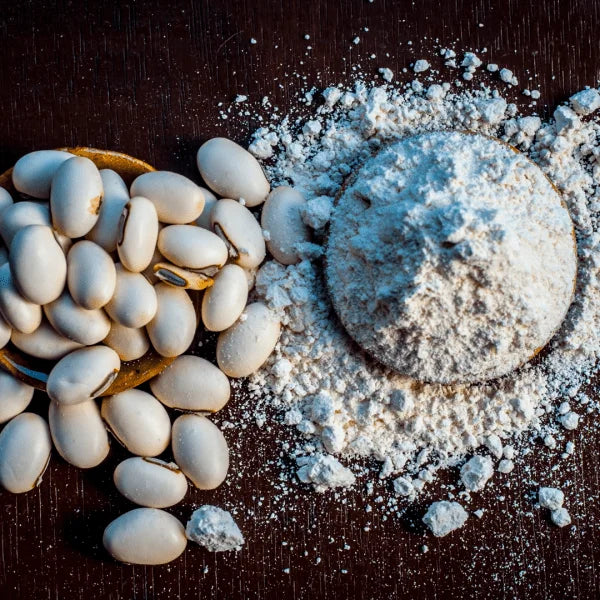
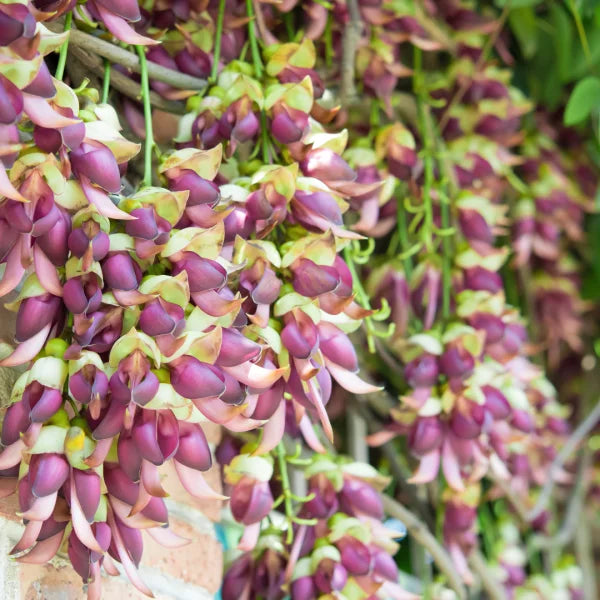
The Richest Natural Source of L-DOPA
Mucuna's seeds are the most concentrated natural source of L-DOPA (levodopa) known, holding several percent by weight. L-DOPA is an amino acid that the body uses as a direct building block for dopamine, one of the brain's key messengers, involved in motivation, focus, mood, and the experience of reward and pleasure.
That single, striking fact is how mucuna earned its famous nickname, the Dopamine Bean. It is a piece of natural chemistry that researchers continue to study closely.
We share this because it is the fascinating science behind the plant, not as a promise about what a cup of cacao will do. The natural levodopa in mucuna is also exactly why the safety notes further down this page matter, so please do read them.
Kapikachhu: Three Thousand Years in Ayurveda
In India, mucuna has been a cornerstone healing plant for around three thousand years, appearing in more than two hundred traditional preparations. The milestones below are cultural and historical heritage, shared to honour the plant rather than as claims about what it does today.
Ancient Roots
Known in Sanskrit as Kapikachhu and Atmagupta, mucuna appears in the oldest layers of Indian plant lore as a treasured tonic seed.
Classical Ayurveda
In the classical texts it is classed as a rasayana, a rejuvenating tonic, and a vajikarana herb, traditionally valued for vigour, stamina and vitality.
More Than 200 Preparations
Across the Ayurvedic tradition every part of the plant has been used, with the seed always considered the most precious of all.
A Food, Too
Beyond medicine, the velvet bean has long been eaten. In Java it is known as Benguk, and even fermented into a tempeh-style food called tempe Benguk.

Sun-Grown on Rajasthan Family Farms
Our mucuna is carefully cultivated on smallholder family farms in and around Rajasthan, India, in the sandy, well-drained soils this plant loves, under warm sun and gentle winds.
The seeds are sown in July, once the rains have moistened the ground, and the crop grows until November or December, when the mature beans are harvested, dried and gently processed. We use only the seed, the richest and most treasured part of the plant.
By choosing it, you support small family growers and a plant tended the way it has been for generations.
The Chemistry of the Velvet Bean
Mucuna is a genuinely complex and nourishing seed. Below are the naturally occurring compounds that make it so interesting, shared as composition, not as health claims. Nothing here is intended to diagnose, treat or prevent any condition.
L-DOPA (Levodopa)
The seed's signature compound and the natural precursor the body uses to make dopamine. The reason for the "Dopamine Bean" name.
Tryptamines & serotonin
Naturally present in the plant, including in the fine hairs of the pod. Part of mucuna's rich and unusual chemistry.
Plant protein & fibre
Mucuna is, at heart, a nutritious legume, naturally rich in plant protein and dietary fibre.
Antioxidants & polyphenols
A broad spectrum of plant compounds typical of a hardy, sun-grown tropical bean.
Minerals
The velvet bean draws minerals from the warm, sandy soils of Rajasthan over its long growing season.
The whole seed
We work with the seed, the part Ayurveda has always prized, rather than offcuts of pod, hair or root.
What Researchers Are Exploring
Mucuna has fascinated scientists almost as much as it has healers. Rather than leave that story untold, here is a careful look at what research has actually explored, shared as education and as the heritage of the plant, never as medical advice or a claim about our cacao.
Dopamine, Mood and Stress
As the richest natural source of L-DOPA, mucuna sits right beside one of the brain's most studied messengers. Researchers have explored its natural levodopa in relation to dopamine, mood, and the body's response to psychological stress. It is a thread of science that keeps the humble velvet bean firmly in the spotlight, and you'll find these studies in our Sources below.
The Levodopa and Parkinson's Story
Mucuna's most remarkable chapter in modern science is also its most serious. The natural levodopa in its seeds is the very same molecule at the heart of conventional Parkinson's medicine, and researchers have run clinical studies comparing seed-derived mucuna with pharmaceutical levodopa, including a much-cited trial published in 2004. This is firmly a medical field. Mucuna is not something to self-prescribe, and anyone living with Parkinson's, or taking levodopa, should only ever explore it under the care of a neurologist. We include it because it is a genuinely extraordinary part of mucuna's story, not as advice or a claim.
An Age-Old Tonic for Vitality
Long before any laboratory, Ayurveda celebrated mucuna as a rasayana and a renowned aphrodisiac: a tonic for vigour, stamina and life force. Modern researchers have been curious enough to study these traditional uses too. We share them as heritage and ongoing scientific interest, which is exactly the spirit in which we named our blend Pasion.
"The warm spark of joy, life force and open-hearted passion."
If chaga is stillness and Lion's Mane is clarity, mucuna is warmth and aliveness. It is the ingredient of pleasure, play and the open heart, which is exactly why we built it into a blend we named for passion itself.
Pasion
Our mucuna is the heart of Pasion: 100% pure ceremonial-grade cacao with mucuna pruriens, rose petals and vanilla. It is the blend we reach for to soften, to feel, and to open the heart.
Energetic profile: soothing, loving, lightness of being, uplifting, arousing, life-force activating.
Sensory notes: smooth, silky, floral.
Discover Pasion
How to Brew Your Pasion
A few unhurried minutes to soften, open and arrive in the heart.
Measure
Add one heaped tablespoon (around 15 to 20 g) of Pasion to your favourite mug or pot.
Warm
Heat 200 to 250 ml of water or plant milk to just below a simmer, never boiling.
Whisk
Pour over and whisk, blend or froth until smooth, silky and gently steaming.
Arrive
Wrap both hands around the cup, breathe, and let your heart soften before the first sip.
The Botanical at a Glance
| Botanical name | Mucuna pruriens |
|---|---|
| Common names | Velvet bean, Kapikachhu, Cowhage, Monkey tamarind, the Dopamine Bean |
| Plant family | Fabaceae (the legume family) |
| What it is | A tropical climbing legume; we use the seed (the velvet bean) |
| Part used | The seed |
| Origin | Smallholder family farms in and around Rajasthan, India |
| Compound of interest | Naturally occurring L-DOPA (levodopa) |
| Found in | Pasion cacao blend |
| EU classification | Sold as a food supplement |
Mucuna Questions, Answered
Why is it called the Dopamine Bean?
What does it taste like in Pasion?
Is it suitable for vegans?
Where does your mucuna come from?
Who should not use it?
Important Safety Notes
Pasion is a food supplement. Keep to the recommended daily portion shown on pack and do not exceed it. Keep out of reach of young children. A food supplement is not a substitute for a varied, balanced diet and a healthy lifestyle.
Because mucuna naturally contains L-DOPA, please do not use it, and speak to your doctor first, if any of the following apply to you:
You are pregnant or breastfeeding (dopamine can affect the hormone prolactin); you take levodopa or other Parkinson's medication; you take MAOI antidepressants or other psychiatric medication; you take blood-pressure medication; or you have a condition affecting dopamine. If in doubt, always consult a qualified healthcare professional before use.
The information on this page is shared for educational and cultural interest only. It is not medical advice and is not intended to diagnose, treat, cure or prevent any disease. Food supplements are not a substitute for a varied, balanced diet and a healthy lifestyle. Always consult a qualified healthcare professional before use if you are pregnant, breastfeeding, or taking medication.
Sources & Further Reading
Mucuna sits where ancient Ayurveda meets modern science. If you'd like to explore further, here are trustworthy starting points. These are independent sources, shared for education, not health claims by Herbal Cacao.
- Scientific researchPubMed, peer-reviewed studies on Mucuna pruriens. pubmed.ncbi.nlm.nih.gov
- Ayurvedic heritageLampariello L.R. et al., "The Magic Velvet Bean of Mucuna pruriens." J Tradit Complement Med, 2012. ncbi.nlm.nih.gov
- Composition & review"Mucuna pruriens: A Dietary Supplement with Balancing Properties." MDPI, Sci Pharm. mdpi.com
- Levodopa & Parkinson's researchKatzenschlager R. et al., "Mucuna pruriens in Parkinson's disease: a double blind clinical and pharmacological study." J Neurol Neurosurg Psychiatry, 2004. pubmed.ncbi.nlm.nih.gov
- Mood & stressResearch exploring Mucuna pruriens and the body's response to psychological stress. ncbi.nlm.nih.gov
- Traditional vitality useShukla K.K. et al., study of Mucuna pruriens and male vitality, exploring a long-standing Ayurvedic use. Fertil Steril, 2009. pubmed.ncbi.nlm.nih.gov
- L-DOPA & dopamineL-DOPA (levodopa), background reference. en.wikipedia.org
 Begin the ritual
Open Your Heart
Joyful mucuna, woven through ceremonial cacao, rose and vanilla.
Get your Pasion